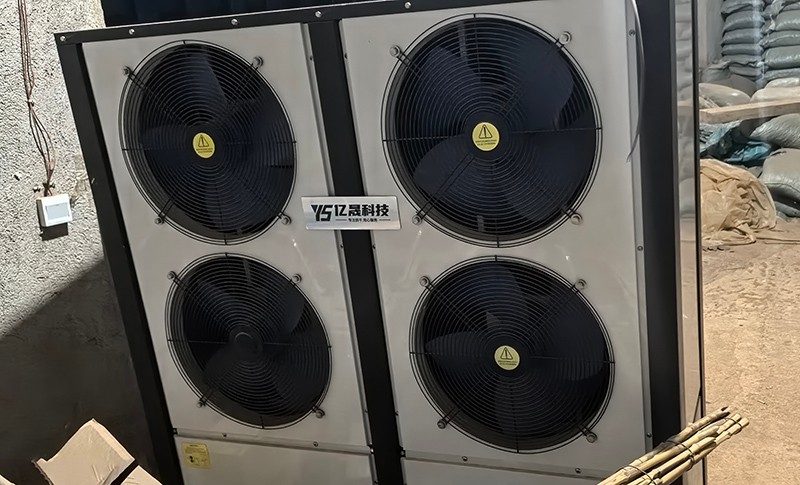
I. The Mind-Bending 'Energy Magic': Working Principle of Air Source Heat Pumps
"Is there really 'heat' in the air?" This is a question many people have when first encountering air source heat pumps. The answer is affirmative—even in cold winters, the air still contains heat (air at 0°C still has a thermodynamic temperature of about 273K). The core of the air source heat pump is to 'capture' this scattered heat through technical means and utilize it centrally.
Its working principle is similar to a household air conditioner running in 'reverse':
1. Heat Absorption: The evaporator in the heat pump unit (similar to the outdoor unit of an AC) absorbs heat from the air through a refrigerant (a substance that evaporates easily), changing the refrigerant from liquid to gas. This step is like a sponge absorbing water; even if the heat in the air is thin, it can be efficiently 'adsorbed'.
2. Compression: The gaseous refrigerant is compressed by the compressor. While the pressure rises, the temperature rises sharply (can reach over 80°C), completing the transformation from 'low-temperature heat' to 'high-temperature heat'.
3. Heat Release: The high-temperature, high-pressure refrigerant enters the condenser (similar to the indoor unit of an AC), transferring heat to the water or air that needs heating, and condensing back into a liquid state. This heat is used for heating, hot water, or other scenarios.
4. Throttling: The liquid refrigerant passes through the expansion valve to reduce pressure and temperature, returning to the evaporator to start the next cycle.
In this process, electricity is mainly used to drive the compressor, rather than directly generating heat. Therefore, the Coefficient of Performance (COP) of air source heat pumps is extremely high—consuming 1 kWh of electricity can generate heat equivalent to 3-4 kWh of electricity (traditional electric water heaters have a COP of only 0.9), making it a 'leader' in the field of energy saving.
II. All-Scenario Penetration: The 'Versatile Player' from Heating to Industry and Agriculture
The advantage of air source heat pumps lies not only in energy saving but also in their super adaptability to scenarios. From family life to industrial production, from the cold north to the humid south, it can find precise application scenarios:
1. Civilian Sector: The 'Invisible Guardian' of Warmth and Comfort
Home Heating and Cooling: In the northern 'coal-to-electricity' projects, air source heat pumps replace traditional coal-fired boilers to provide constant temperature heating for rural residences, keeping room temperatures stable at 18-22°C without coal ash pollution; in the south, heat pump all-in-one units can achieve 'winter heating + summer cooling,' solving the pain points of 'bone-chilling damp cold' and 'unbearable muggy heat' in the south, being more energy-efficient than air conditioners and more flexible than radiators.
Central Hot Water Supply: Hotels, schools, hospitals, and other places have a high demand for hot water. Air source heat pump hot water units can produce hot water stably 24 hours a day, with water temperatures reaching 55-60°C and low operating noise. After a chain hotel used it, hot water energy consumption was reduced by 60%, saving hundreds of thousands of yuan in electricity bills annually.
Constant Temperature Swimming Pools: Heating pool water via heat pumps and maintaining a constant temperature (26-28°C) allows for 'swimming in all seasons' even in winter, with energy consumption only 1/4 of electric heating.
2. Industrial and Agricultural Sectors: The 'Energy Engine' of Green Production
Agricultural Planting: In greenhouses, air source heat pumps can precisely control temperature (e.g., keeping flower greenhouses at 25°C, seedling nurseries at 30°C). Combined with humidity regulation, they enable off-season crop growth. After a strawberry greenhouse in the north used it, winter energy consumption dropped by 50%, and yield per mu increased by 30%.
Livestock Breeding: Provides a constant temperature environment for farms (30°C for piglet nurseries, 20°C for layer hen houses), reducing livestock diseases and improving survival rates. Compared to traditional coal heating, there are no exhaust emissions, improving the breeding environment.
Industrial Heating: In industries like food processing, electroplating, and dyeing, which require large amounts of hot water or low-temperature heat sources (40-60°C), air source heat pumps can replace electric heating or gas boilers, meeting production needs while reducing carbon emissions. A food factory used heat pumps to heat cleaning water, achieving an annual carbon reduction of 120 tons.
III. Breaking Boundaries: Technical Evolution from 'Fearing Cold' to 'Resisting Extremes'
Early air source heat pumps were criticized for 'poor low-temperature performance'—when the temperature dropped below -5°C, heating efficiency would drop significantly, or they would even fail to start. However, with technical iterations, this shortcoming has been overcome. New-generation heat pumps have achieved 'all-climate adaptation' through three major innovations:
Jet Enthalpy Technology: An injection port is added to the compressor to suck in intermediate-pressure refrigerant, improving compression efficiency. Even in a -25°C environment, heating capacity can maintain over 80% of the design value.
Anti-freeze and Defrosting System: Intelligent sensors monitor the frosting situation of the evaporator and automatically start reverse-cycle defrosting or electric auxiliary defrosting, ensuring no frosting and no shutdown at low temperatures.
Dual-source Heat Pump Technology: In extremely cold regions, a 'air + ground source' dual mode can be used. When the air temperature is too low, it automatically switches to ground source heating (utilizing the constant temperature characteristic of soil) to ensure stable operation.
These technological breakthroughs have allowed air source heat pumps to expand from being 'applicable south of the Yangtze River' to being 'usable in severe cold regions of the Northeast and Northwest,' and can even operate stably in parts of the Qinghai-Tibet Plateau, truly achieving 'full coverage'.
IV. Win-Win for Environment and Economy: The Contemporary Value of Air Source Heat Pumps
In the context of 'Dual Carbon' goals and energy transformation, the value of air source heat pumps is becoming increasingly prominent:
Carbon Reduction Tool: Compared to electric heating, air source heat pumps consume only 0.25-0.3 kWh of electricity to generate 1 kWh of heat, equivalent to reducing CO2 emissions by over 70%; when replacing coal heating, they can reduce sulfur dioxide and dust emissions by over 90%, making them an effective means to control smog and improve air quality.
Energy Security: China's energy structure has a high proportion of coal, while air energy is an 'inexhaustible' renewable energy. Promoting heat pumps can reduce dependence on fossil fuels and increase the energy self-sufficiency rate.
Economic Affordability: Although the initial investment for air source heat pumps is higher than traditional equipment (about 2-3 times that of electric water heaters), operating costs are extremely low, and the price difference is usually recovered in 3-5 years. Taking a 100-square-meter residential heating as an example, the average monthly electricity bill for an air source heat pump in winter is about 500 yuan, only 1/4 of electric heating and 1/2 of gas heating.
Today, from the 'coal-to-electricity' projects in Beijing to rural revitalization projects in Yunnan, from newly built commercial housing to old community renovations, air source heat pumps are becoming the 'new standard' for energy choices. It is not just a device but represents an energy philosophy of 'symbiosis with nature'—not competing with nature for resources, but cleverly utilizing nature's gifts to find the perfect balance between warming life and protecting the environment.
In the future, with the combination of photovoltaics and heat pumps ('photovoltaic + air energy' achieving energy self-sufficiency) and the popularization of intelligent control systems (adjusting energy consumption on demand), air source heat pumps are bound to shine even brighter in the wave of green development, turning every wisp of air into the power for a warm life.